
When Jensen Huang speaks, the global tech world listens. As the visionary founder and CEO of Nvidia, the company powering the modern artificial intelligence revolution, Huang has a reputation for making daring predictions that often become reality. From pioneering GPU computing to fueling the rise of generative AI, he has repeatedly shaped the technological direction of industries worldwide.
Now, Huang has set his sights on a new frontier: helping transform the United Kingdom into a global “AI superpower.” His bold vision, outlined during multiple visits to Britain and expressed through a series of major strategic collaborations, investments, and technology rollouts, signals a future where the UK plays a central role in global artificial intelligence innovation.
But what exactly does Jensen Huang’s plan entail? Why does Nvidia see such massive potential in the UK? And how could his strategy reshape the nation’s economy, research landscape, and position in the global AI race?
This in-depth article explores the driving forces behind Nvidia’s UK ambitions, the elements of Huang’s roadmap, and the long-term implications for technology, industry, education, and national competitiveness.
A Timely Vision for a Rapidly Transforming World
The world is in the midst of an unprecedented AI transformation. From autonomous vehicles to drug development, climate modeling to financial forecasting, artificial intelligence has emerged as a foundational technology, one that will define the next century just as electricity and the internet defined previous eras.
As this transition accelerates, countries around the world are scrambling to establish leadership positions. The United States and China dominate the race, but nations like France, Japan, South Korea, and Singapore are making major strides. The United Kingdom, with its academic excellence, startup energy, and historic influence, has enormous potential, but it faces structural limitations.
Jensen Huang believes the UK has what it takes to become a global leader, but only if it invests aggressively, builds state-of-the-art infrastructure, and aligns industry, government, and academia toward a unified AI vision. His plan aims to support exactly that.
According to Huang, access to advanced computing is the single most important driver of AI leadership. And as the CEO of the company producing the world’s most sought-after AI chips, he is uniquely positioned to accelerate Britain’s transformation.
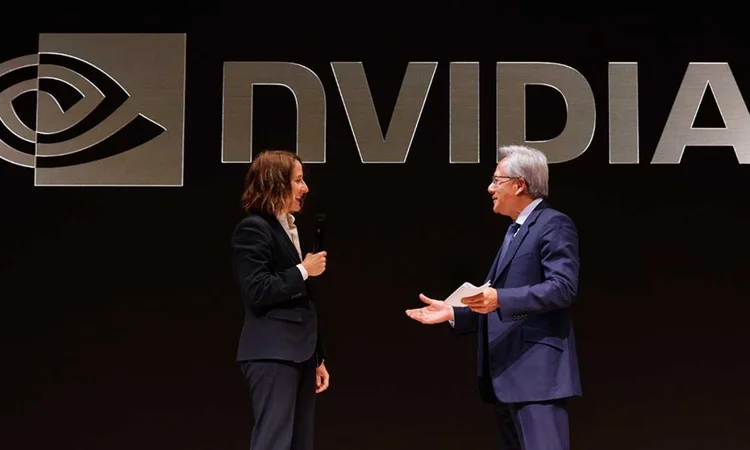
Why Nvidia Sees the UK as a Future AI Superpower
[Source - NVIDIA Blog]
Huang’s interest in the UK is rooted in several strategic advantages that the country already possesses.
The first is world-class research talent. The UK is home to some of the most respected AI research institutions, including the University of Cambridge, the University of Oxford, Imperial College London, and DeepMind’s headquarters in London. These institutions contribute significantly to global AI breakthroughs and attract top-tier talent from around the world.
The second advantage is the UK’s vibrant startup ecosystem. London, Cambridge, Edinburgh, and Manchester have become hubs for AI-driven startups in sectors such as finance, biotech, gaming, and climate technology. Despite economic challenges, British entrepreneurs continue to attract global investment, making the UK the strongest European competitor in AI innovation.
The third advantage is a historically strong regulatory and governance framework. While still evolving, the UK’s AI policy approach has been praised for promoting innovation while protecting public safety, creating an environment where companies can experiment, collaborate, and scale with confidence.
Huang believes these strengths place the UK in a unique position, but only if it can harness them effectively. Nvidia’s role, as he sees it, is to provide the computing power, tools, and partnerships that make this possible.
Supercomputers, AI Data Centers, and the Power of Compute
At the center of Huang’s plan lies a powerful idea: nations that want to lead in AI need massive computational power. In Huang’s words, “AI development is limited by compute. If you have more compute, you can do more science.”
To support this belief, Nvidia is working closely with UK institutions to develop some of the world’s most advanced AI computing hubs.
The crown jewel of this effort is the Cambridge-1 supercomputer, which Nvidia built in collaboration with UK partners. Cambridge-1 is one of the most powerful AI supercomputers in Europe and is dedicated to advancing research in healthcare, genomics, drug discovery, and climate science. It has already been used by leading institutions such as AstraZeneca, GSK, and King’s College London.
But Cambridge-1 is just the beginning. Huang’s vision includes:
A network of next-generation AI supercomputing facilities
National access to Nvidia’s accelerated computing platforms
Expanded GPU clusters across universities and enterprise sectors
AI “factories” capable of training large foundation models
These supercomputers aren’t just designed for research, they are designed to power entire industries. From financial modeling to autonomous vehicles, from digital twins to applied genomics, the UK’s future industrial capabilities will depend heavily on access to advanced computational infrastructure.
Nvidia’s involvement ensures that the UK stays ahead in the global “compute race,” one of the defining competitive battles of the decade.
Transforming Industries Through AI: Nvidia’s UK Partnerships

[Source - NVIDIA Blog]
Another key pillar of Huang’s AI superpower strategy involves transforming major UK industries by embedding AI into their operations. Nvidia is partnering with leading British companies across sectors to accelerate innovation and economic growth.
Healthcare is one of the most promising areas. The UK’s National Health Service, with its vast medical data and integrated patient systems, provides an extraordinary opportunity to apply AI for early diagnosis, personalized medicine, and operational efficiency. Nvidia’s AI tools and frameworks can help unlock insights from medical imaging, patient histories, and genomic data at scale.
Finance is another critical sector. As one of the world’s financial hubs, London’s banks and fintech companies are integrating AI to improve risk assessment, fraud detection, algorithmic trading, and customer experience. Nvidia’s accelerated computing platforms allow these institutions to process complex financial models in real time.
Manufacturing is also seeing rapid transformation. With Nvidia’s Omniverse platform, UK industries can design and operate “digital twins” of factories, supply chains, and infrastructure systems, reducing costs, increasing safety, and accelerating time-to-market.
The automotive sector, especially in emerging fields like autonomous driving, is another major beneficiary. Nvidia’s DRIVE platform supports AI-powered mobility innovation, enabling UK companies to test, simulate, and develop next-generation transportation systems.
These industry partnerships demonstrate Huang’s belief that a true AI superpower is not defined by research alone; it is built by integrating AI into every layer of the economy.
A New Era of AI Talent Development
A country cannot become an AI superpower without strong talent pipelines, and this is one area where Huang has made a clear call to action.
During his visits, he emphasized that AI fluency must become a foundational skill, not just for engineers and coders, but for professionals across every field. The UK, he argues, must invest in updating its education system to reflect the needs of an AI-driven economy.
This includes strengthening STEM programs, expanding access to digital skills training, and building partnerships between universities and technology companies. Nvidia itself has played a direct role through initiatives such as the Nvidia Deep Learning Institute, which offers training programs, workshops, and certifications for AI practitioners.
Huang believes that nurturing AI talent requires more than technical instruction. It also calls for cultivating creativity, interdisciplinary thinking, and entrepreneurial spirit. Only then can the UK produce the next generation of AI founders, researchers, and innovators who will shape the country’s economic future.
Policy, Regulation, and the UK’s Strategic Advantage
While many countries struggle to balance innovation and regulation, Huang believes the UK is well positioned to lead with a pragmatic and forward-thinking approach.
He has frequently praised the UK’s attempts to develop AI regulation that supports innovation while ensuring safety and accountability. This regulatory maturity, combined with Britain’s culture of scientific inquiry, gives the country a unique advantage in building international trust in its AI strategies.
However, he also warns against overregulation. Excessive restrictions, he argues, could push talent and investment elsewhere. The challenge for the UK, and for any nation pursuing AI leadership, is to strike the right balance.
In Huang’s view, policymakers must avoid regulating AI technology itself and instead focus on regulating its applications. This approach would allow innovation to flourish while protecting citizens from misuse.
Building an AI Superpower: Economic Growth and Global Influence
If executed effectively, Huang’s plan has the potential to transform the UK’s economic landscape.
Becoming an AI superpower would stimulate high-tech job creation, attract international research partnerships, and position Britain as a leading destination for AI investment. The country could witness breakthroughs in health, energy, citizen services, finance, logistics, and national infrastructure.
Nvidia’s role in this transformation extends beyond technology. By establishing deep roots in Britain’s research institutions, cloud infrastructure, and enterprise ecosystems, Nvidia aims to act as both a catalyst and partner in the nation’s AI-driven growth.
In addition to economic impact, this strategy holds geopolitical significance. As nations compete for influence in the global AI order, the UK’s leadership could strengthen its international standing, deepen alliances, and enhance its role in shaping ethical AI standards worldwide.
The Road Ahead: Challenges and Responsibilities
[Source - LinkedIn]
Although Huang’s vision is ambitious and promising, it is not without challenges. The UK still faces limitations in accessing skilled labor, scaling infrastructure, and competing with the financial powerhouses of the US and China.
Electricity demands for AI computing, energy sustainability concerns, and rising hardware costs remain obstacles. Political uncertainty and shifting policy priorities can also stall momentum.
Nevertheless, Huang remains optimistic. He believes these challenges can be overcome through strategic partnerships, aggressive investment, and a long-term commitment to building a thriving AI ecosystem.
Above all, he emphasizes the importance of responsible leadership. AI must be developed with care, transparency, and ethical consideration. The goal is not merely to build powerful technology, but to build technology that elevates society, improves human welfare, and strengthens national resilience.
Conclusion: A Vision That Could Redefine the UK’s Digital Destiny
Jensen Huang’s plan to help make the UK an “AI superpower” is more than a corporate initiative; it is a bold and transformative vision for the country’s technological future. Through advanced computing infrastructure, industry partnerships, talent development, regulatory collaboration, and deep investment in research, Nvidia aims to play a pivotal role in shaping the next era of Britain’s digital evolution.
The UK stands at a critical moment. With the right strategy, leadership, and long-term commitment, it has the potential to stand alongside the world’s top AI nations. And with Nvidia’s unparalleled expertise at its side, this transformation feels increasingly within reach.
Huang’s message is clear: the future belongs to countries that embrace AI with purpose, skill, and ambition. The UK has already taken its first steps; now it must accelerate, innovate, and lead.
If successful, this vision will not only reshape Britain’s economy but also influence the global balance of technological power for decades to come.


Leave a Reply
Your email address will not be published.