

[source - Docebo]
In the evolving business landscape, where organizational success hinges on adaptability, talent development, and operational efficiency, learning has emerged as a strategic differentiator. And at the heart of this transformation stands Docebo, a company that has not only built the world’s most powerful learning experience platform but also redefined how enterprises approach training, onboarding, and engagement.
From its roots in Italy to becoming a global player listed on the Toronto Stock Exchange and Nasdaq, Docebo has followed a trajectory of innovation, vision, and performance. This blog explores the inspiring journey of Docebo, how it became a leader in enterprise learning, what sets it apart, and why its model resonates so strongly with CEOs, startup founders, and global business managers.
The Genesis: Identifying the Gap in Learning Technology
Founded in 2005, Docebo was born from the realization that traditional LMS systems were no longer fit for modern businesses. The market was flooded with clunky, compliance-driven platforms that focused more on administration than on learner engagement. Docebo saw the opportunity to pivot the purpose of corporate learning from a cost center to a strategic growth enabler.
Its early platform embraced simplicity, scalability, and cloud-native delivery—an approach that disrupted the status quo. The goal was clear: to offer organizations a learning experience platform that wasn’t just reactive but predictive, intelligent, and outcome-driven.
Strategic Scaling: From Startup to Stock Exchange

[source - Docebo]
Docebo's real inflection point came when it strategically relocated its headquarters to Toronto, tapping into the North American enterprise market. This move, combined with its 2019 IPO on the TSX and subsequent listing on Nasdaq in 2020, placed Docebo in a strong position to attract global clients and capital.
The transition from a privately held company to a publicly traded one catalyzed growth across all verticals. With offices across the U.S., Canada, Italy, the U.K., and beyond, Docebo’s international footprint rapidly expanded. Its cloud-based learning experience platform was adopted by thousands of enterprise clients seeking agility, automation, and insights in their learning systems.
Product Differentiation: Built for the Business of Learning
Docebo has successfully positioned itself as more than an LMS. It introduced a full-suite learning experience platform powered by AI, designed to meet the needs of every learning audience—internal employees, external partners, and even customers. This product-centric innovation has enabled companies to leverage learning as a strategic function across the value chain.
Some of the most impactful features that distinguish Docebo include:
AI-Powered Content Recommendations: Personalizes content delivery based on user behavior and organizational goals.
Docebo Shape: Enables quick content creation using generative AI, reducing production time while maintaining quality.
Docebo Learn Data: Offers deep analytics and dashboards that help L&D leaders tie learning to performance KPIs.
Docebo for Extended Enterprise: Supports channel partner enablement and customer education with equal ease.
The end result? A learning experience platform that doesn’t just deliver content��it aligns learning with business outcomes like productivity, retention, and revenue growth.
Financial Performance: Turning Learning into a Growth Engine
[source - Docebo]
Behind Docebo’s technology lies a powerful business engine. In 2024, the company reported a net profit of $26.7 million, a tenfold increase from $2.8 million in 2023. Annual revenue soared to $216.9 million, of which 94% came from recurring subscriptions. This signals not only customer trust but also product stickiness and scalability.
What drives this success?
Strong SaaS Economics: High gross margins (~80%) and low churn.
Enterprise-Focused Sales: Deep relationships with global clients in sectors like healthcare, manufacturing, financial services, and retail.
Innovative R&D: Continuous reinvestment in platform enhancements and AI features.
It’s no surprise that Docebo’s learning experience platform has become a budget priority for CHROs and Chief Learning Officers navigating hybrid and distributed workforces.
Case in Focus: YMCA of the USA
One of Docebo’s most prominent enterprise transformations was for the YMCA of the USA. Faced with fragmented training programs across hundreds of local associations, the YMCA turned to Docebo to build a centralized learning experience platform. The results were transformative—consistent onboarding, leadership development programs, and compliance training at scale.
This story is just one among thousands. Docebo’s clientele includes names like Thomson Reuters, Walmart, Amazon Web Services, and Heineken. Each of these organizations trusts Docebo to enhance performance through better learning.
AI and the Future of Personalized Learning
As digital transformation accelerates across industries, the need for adaptive, personalized, and contextual learning has never been higher. Docebo's investment in artificial intelligence has redefined what a learning experience platform can do.
The platform uses machine learning to:
Detect learner behavior patterns
Curate and push relevant content
Predict training needs before skill gaps arise
Automate administrative tasks for HR and L&D teams
This makes Docebo’s offering not just tech-savvy but future-ready. Organizations leveraging their AI capabilities report improved learner engagement and faster onboarding, directly impacting time-to-productivity and ROI.
Leadership with a Global Vision
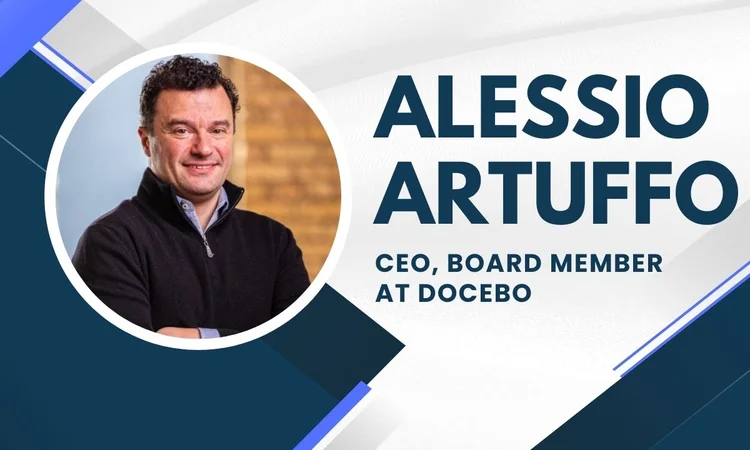
Docebo’s CEO Alessio Artuffo is a visionary leader who combines operational acumen with a customer-first mindset. Under his guidance, the company has stayed committed to innovation while scaling profitably.
Artuffo’s leadership principles emphasize:
Customer Centricity: Building long-term relationships through support and personalization.
Product-Led Growth: Ensuring features solve real business problems.
Agile Decision-Making: Operating lean and fast in a competitive environment.
This leadership has translated into cultural strength as well. Docebo is consistently recognized as a top workplace, attracting talent globally and promoting diversity, collaboration, and growth from within.
Why Docebo Matters for CEOs and Startup Leaders?
In a time when economic uncertainty demands sharper decision-making and efficient operations, enterprise leaders can no longer afford to view learning as a back-office function. CEOs and startup founders must consider:
How can learning systems accelerate digital adoption?
How can onboarding time be reduced without sacrificing quality?
How do we ensure every employee, partner, or customer knows our products inside out?
Docebo answers all of these through its AI-enabled learning experience platform, helping leaders translate learning into business impact.
Expansion and the Road Ahead
As of 2025, Docebo continues to grow across North America, Europe, Asia, and LATAM. The company is focused on:
Enhancing the learning ecosystem through native integrations with Microsoft Teams, Salesforce, Zoom, and other tools.
Broadening the product stack with microlearning, gamification, and social learning features.
Doubling down on analytics to help managers tie learning to revenue, customer satisfaction, and workforce productivity.
By 2030, Docebo envisions becoming the most comprehensive learning experience platform for the enterprise sector—a goal it is already well on its way to achieving.
Conclusion
Docebo’s journey is more than a success story; it’s a blueprint for how to scale responsibly, innovate continuously, and build with customer empathy. For today’s business leaders, the message is clear. Build learning into your business DNA, not as an afterthought but as a competitive lever. Choose platforms that grow with your needs and deliver insights, not just administration. Invest in AI-powered learning that prepares your teams for tomorrow, today. As enterprises look for smarter ways to grow, engage, and perform, Docebo stands tall as the learning experience platform of choice, a partner for the future of business learning.










Leave a Reply
Your email address will not be published.