


The upcoming COP30, slated for Belém, Brazil, has been billed as an inclusive gathering, open to all, with thematic days spanning energy, nature, agriculture, and finance. But behind this open-door framing lies a harder question: will business leaders actually show up in force?
Over recent COPs, the private-sector presence has been uneven. Promises of corporate leadership often clash with practical constraints, strategic timing, or conflicting incentives. In this article, we explore the motivations, hurdles, and scenarios influencing whether business leaders will attend COP30, and whether their presence will matter.
1. Why Their Attendance Matters
Before interrogating whether they will come, it’s essential to understand why their presence would be significant.
Signalling & legitimacy: When business leaders show up, it signals to governments and civil society that private capital and industry take climate commitments seriously. Their absence, in contrast, can convey lukewarm engagement.
Policy influence: The COP is a stage where corporate actors can advocate for favorable policy frameworks, carbon pricing, regulation, incentives, and public-private partnerships. Presence enables direct dialogue with negotiators.
Mobilizing capital & innovation: Many climate solutions will require large-scale investment, technology development, and cross-sector collaboration. Business involvement helps translate ambition into execution.
Accountability & transparency: When corporations engage publicly, they expose themselves to scrutiny and are more likely to be held to their pledges.
These dynamics are not hypothetical. The We Mean Business Coalition has explicitly called for a strong corporate presence at COP30, arguing that “business being present brings unique value: the innovation, capital, and operational expertise needed to deliver the transition.” Thus, business attendance isn’t just about optics; it’s part of the ecosystem needed for climate action.
2. A Rocky Recent Record: What the Past Teaches Us
To forecast COP30, we must look at recent COPs to see how business engagement has fared. The pattern shows both peaks and troughs, underscoring that attendance is not guaranteed.
COP28 (Dubai, 2023): A milestone in scale, with over 85,000 participants, including strong business representation. The business and innovation sectors were highly visible. But critics flagged that the size itself created inefficiencies.
COP29 (Baku, 2024): A step back. Many business leaders and finance chiefs reportedly skipped the summit or sent leaner delegations. Media coverage described COP29 as a “finance COP” in name, but many top finance executives declined to attend. As one FT article put it: “You only go to the party if everyone is going.”
In addition, logistical constraints, capacity caps, and political uncertainty (especially tied to U.S. elections) were cited as deterrents.
From this, we derive key lessons:
Attendance is nonlinear: a “down year” can occur even after a high-water mark.
External context (politics, host nation, logistics) plays a major role.
Some sectors (e.g., fossil fuel lobbyists) maintain a presence even when others retreat.
Thus, COP30 cannot assume business will auto-attend just because past COPs have been popular.
3. The COP30 Context: Unique Opportunities and Barriers

Belém, in the Amazon basin, offers both a symbolic platform and a logistically challenging environment. The setting is designed to foreground nature, deforestation, indigenous rights, and land restoration. Yet such symbolism carries real constraints.
Business opportunities:
Thematic breadth and relevance: COP30’s agenda spans energy, agriculture, nature-based solutions, finance, and just transitions, domains intimately tied to business strategy and climate impact.
Regional markets & value chains: Latin America is rich in carbon sinks, biodiversity, agriculture, and natural resources. Businesses with interests in forestry, bioeconomy, agritech, and ecosystems will find the location pertinent.
Symbolic gravitas: Locating COP in the Amazon sends a signal about prioritizing nature-based solutions. Companies in carbon markets, climate finance, and restoration will want to be seen as contributing.
Local presence & cost advantage: Latin American firms and regional multinationals may find participating more accessible than when COPs are hosted in faraway geographies.
Barriers & disincentives:
Travel & logistics: Belém is remote, and flights, accommodation, and infrastructure upgrades are still underway. Companies may balk at complexity and cost.
Carbon hypocrisy & optics risk: CEOs flying long-haul from distant capitals could face criticism of contradiction, attending a climate summit while generating emissions.
Dilution & capacity constraints: If COP30 maintains the large scale of COP28, many will question the effectiveness of being one voice in a sea of 60,000+ delegates.
Unclear payoff: If COP30’s outcomes lean technical or incremental, businesses may question the return on investment of sending top executives.
Regulatory uncertainty: Brazil’s own climate and land-use policies may complicate the environment in which companies operate, making them cautious in associating with a COP that might spotlight contradictions.
Selectivity & gatekeeping: Some space, meetings, or side-events may favor insiders or national delegations, limiting access for pure business representatives.
Other channels: Businesses may prefer side events, regional or sectoral forums, or climate summits closer to their markets.
4. The Pivotal Question: Will They Attend, and Who?
Given the above, we can sketch plausible scenarios for corporate attendance at COP30.
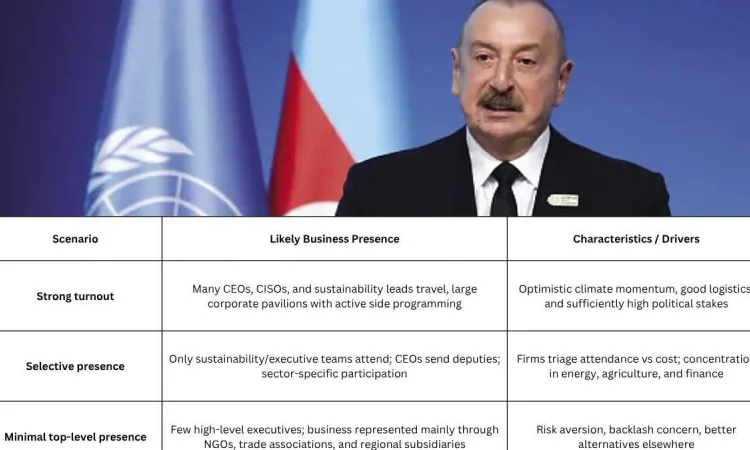
I lean toward a selective presence scenario: not a full CEO turnout, but respectable representation, especially from climate-forward firms, energy/agribusiness sectors, and climate finance.
Factors likely to influence decisions:
Sector relevance: Energy, natural resources, forestry, agriculture, water, carbon markets, and climate tech will be more motivated.
Geographic proximity: Latin American and regional enterprises will have an advantage.
Brand and reputation calculus: Firms with strong ESG positioning may see reputational upside, while high-carbon companies may shy away from scrutiny.
Agenda alignment: Firms whose business models align with COP30’s thematic days will see better returns on engagement.
We should also watch whether some business leaders plan to “skip COP29 to be at COP30”, a strategy some reportedly adopted when COP29 was viewed as overly technical or misaligned.
5. How Corporate Attendance Can Be More Than a Photo Op
If business leaders do attend, how can they ensure their presence is substantive rather than ceremonial? Here are strategies and pitfalls:
Do:
1. Come with concrete, credible deliverables
Investment commitment announcements
Technology deployment plans
Partnerships in nature restoration, supply chain decarbonization
2. Integrate with public policy discourse
Lobby for robust carbon pricing, regulatory clarity, and finance mechanisms
Join side negotiations and open dialogues, not just closed industry talks
3. Prioritize authenticity and accountability
Be transparent about emissions, supply chain impacts
Accept scrutiny and engage critics rather than hide from them
4. Leverage cross-sector participation
Collaborate with NGOs, governments, and indigenous groups
Use the thematic days to connect horizontally (e.g., agriculture + finance + biodiversity)
5. Use the stage to influence markets, not just media
Signal to investors, financiers, and partners that your firm expects a net-zero future and is aligning accordingly
Avoid:
Overhyping marginal “green” moves while core business models remain carbon-intensive.
Treating COP as just a marketing exercise.
Attempting to dominate rather than contribute, this alienates civil society and negotiators.
Bringing large delegations without clear value-add signals overcommitment or greenwashing.
If done well, presence at COP30 can shape policy, not just ride it.
6. What Will Business Absence Mean?
If business leaders largely stay away from COP30, the implications could be damaging:
Legitimacy vacuum: Governments and the public may question the private sector's commitment to climate action.
Weaker public-private collaboration: Without corporate voices at the table, bridging mechanisms may falter.
Reduced investment signals: A lack of announcements or capital commitments could slow market momentum.
Loss of influence: Policies may be shaped without business input, potentially leading to misaligned incentives or abrupt regulatory shifts.
In the absence of business, other actors (governments, NGOs, philanthropic funds) will have more influence. But climate transitions require alignment across all sectors; the absence of capital and industry at COP risks disconnecting ambition from implementation.
7. Strategies for Encouraging Business Attendance

Policymakers, COP organizers, and civil society can play a role in nudging business attendance:
Provide incentives: subsidized travel, special corporate access tracks, integration into public sessions.
Curate business-friendly programming: ensure business-relevant tracks, matching sessions, and cross-collaboration spaces.
Limit scale & manage overcrowding: large COPs can deter participation; smaller, more structured gatherings may be more inviting.
Transparency & accountability mechanisms: demand measurable outputs and reportbacks to give business attendees confidence that effort is meaningful.
Encourage hybrid & satellite models: for those unable to travel, virtual or regional hubs can still engage business in parallel.
The We Mean Business Coalition is already advocating for such facilitation, stressing the need for corporate presence to “drive momentum, keep ambition high in negotiations and show the private sector is ready to act.”
Conclusion: The Door Is Open, but Will They Walk In?
COP30’s framing as “open to all” sets an ambitious tone, symbolically inclusive, thematically diverse, and globally relevant. But inclusion is only meaningful if the people whose decisions shape industry and capital actually walk through the doors.
There’s reason for guarded optimism: climate urgency is rising, ESG narratives are more central than ever, and companies recognize they cannot opt out of the transition. But practical, reputational, and strategic constraints can still hold back top-level involvement.
The likely outcome? Selective, strategic presence. Some CEOs will attend, mainly in sectors closely tied to climate solutions; others will send deputies. But we probably won’t see a full corporate spectacle like Dubai’s COP28. Instead, the real test will be: who shows up, what they bring, and how they leverage platforms to influence the trajectory of global climate action.
In the end, COP30 can only deliver on its promise of inclusion if business leaders decide that showing up is not optional, but essential.








Leave a Reply
Your email address will not be published.