

When OpenAI burst into public consciousness with ChatGPT, it was the consumer experience that captured the headlines: conversations, creativity, curiosity. But as generative AI matures, the stakes have shifted, and so has leadership. Sam Altman, CEO of OpenAI, is now leading with a sharpened strategic lens toward enterprises: building infrastructure, forging partnerships, and aligning product offerings to business needs.
This article examines how Altman is using new alliances to drive enterprise growth, what those alliances are, how they fit into OpenAI’s broader strategy, what risks are involved, and what this could mean for the AI industry and business trust in the years ahead.
1. From Consumer Buzz to Enterprise Business: The Strategic Shift
OpenAI under Altman has always balanced its mission of advancing AI and making it widely useful. But in 2025, he has been explicit: the company is pivoting (or perhaps expanding) from consumer-first to enterprise-first in many dimensions.
Some key triggers for this strategic shift:
Maturation of models: Earlier AI models were more experimental, but newer versions (ChatGPT Enterprise, API offerings, specialized models) are better suited to robustness, scale, and business integration.
Revenue diversification pressure: Consumer products are powerful engagement tools, but enterprise contracts tend to bring in steadier, often larger revenue streams and long-term contracts. Altman has acknowledged that profitability is not the top concern now, but business sustainability is.
Infrastructure demands: Modular scaling of compute, storage, memory, data centers, chips, all of which enterprises deeply care about and which influence performance, latency, cost, regulation, and security. Scaling these efficiently usually requires strong alliances.
Thus, Altman is leading OpenAI into a phase where alliances aren’t just nice to have, they are central to the company's operating model for enterprise readiness.
2. Key Alliances: What They Are & What They Do
[Source - TechDodo]
To execute on the enterprise pivot, Altman is building and deepening several kinds of alliances: with enterprises (for product usage), with hardware and infrastructure providers, and with governments/regulatory ecosystems. Some of the most important ones:
2.1 App & Product Partners
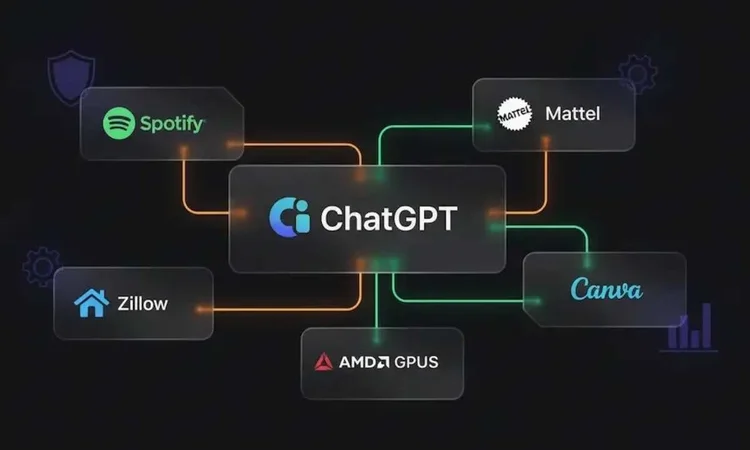
Spotify, Zillow, Booking.com, Mattel: Through various “app integrations,” these companies are enabling ChatGPT (or OpenAI tools) to plug directly into their platforms. For example, letting users generate playlists via ChatGPT-Spotify integration, and Zillow allowing filtered property searches via ChatGPT.
Mattel & Sora 2 video model: Mattel is using OpenAI’s Sora 2 video model in its product development process. That means early sketches or design ideas can be turned into visuals more quickly, shrinking design cycles and enabling creative/productive leverage.
These alliances serve not only to embed OpenAI’s models deeper into enterprise workflows but also to stress-test them, improve them, and showcase their utility for the more conservative, value-sensitive business world.
2.2 Infrastructure & Hardware Alliances
Stargate initiative: Perhaps the biggest structural alliance. Altman has pushed for OpenAI’s massive "Stargate" infrastructure plan (estimated at hundreds of billions of dollars) in partnership with players like SoftBank, Oracle, Samsung, SK Hynix, SK Telecom, etc. The goal: scaling data centers, increasing memory chip production (for example, DRAM wafer starts), and building regional capacity in places like South Korea.
Samsung / SK Telecom / Government ministries: In Korea, OpenAI has partnered with Samsung Electronics, SK Hynix, and the Korean Ministry of Science & ICT, among others, to build out data centers; to produce chips/memory; to ensure local supply chain capacity; and to functionally distribute some AI services via local resellers (for example, Samsung SDS acting as a reseller of OpenAI services).
2.3 Organizational Leadership & Internal Alignment
Expanded roles for executive leadership: Altman has revised internal responsibilities to ensure that global deployment, partnerships, infrastructure, and operational excellence are overseen with focus. For example, Brad Lightcap, OpenAI’s COO, has taken on can enlarged responsibility to spearhead these global growth and infrastructure partnerships.
Product & research integration: Mark Chen’s role was expanded to integrate research and product development more tightly, ensuring that innovations are not siloed but more seamlessly incorporated into enterprise-relevant offerings.
3. Why These Alliances Matter: What Altman Gains
These partnerships and alliances deliver multiple strategic benefits, positioning OpenAI in a favorable place in enterprise AI. Here are some of the key gains:
3.1 Scale, Reliability & Performance
Enterprise customers care about uptime, latency, data privacy, and regional availability. Through infrastructure alliances (data centers, local partners, memory/chip supply), OpenAI improves its ability to deliver reliable, performant, and localized services. For example, having local data center capacity in Korea reduces latency for Asian customers, helps with regulatory compliance, and lessens dependency on far-off infrastructure.
3.2 Lowering Infrastructure Risk & Cost
Scaling compute, DRAM, and chips is capital-intensive. By partnering with hardware manufacturers, governments, and large infrastructure providers, Altman ensures OpenAI doesn’t bear all the upfront risk alone. These alliances help share cost, supply chain risk, and geopolitical risk (e.g., dependencies on foreign suppliers, trade restrictions, import/export concerns).
3.3 Faster Time to Value: Product Adoption & Integration
By embedding OpenAI’s models into existing enterprise workflows, in apps, via APIs, and partnerships with recognizable brands, Altman accelerates adoption. Enterprise clients often need concrete case studies. Working with Mattel on design workflows, Spotify/Zillow etc. gives OpenAI tangible proof that its models can do real-business work, not just generic text generation.
3.4 Reputation & Trust Building
Enterprises are more risk-averse than consumer users. Trust, privacy, local regulatory alignment, deliverables, accountability are crucial. Partnerships in infrastructure (e.g. local data centers), prominent app integrations with large brands, and transparency around enterprise offerings (how data is used, whether models are updated, what guarantees exist) build legitimacy. Altman seems keenly aware that OpenAI must manage perception as much as architecture.
3.5 Strategic Control & Independence
OpenAI has a deep relationship with Microsoft, which is both a partner and a major investor/cloud provider. But relying too heavily on one source of infrastructure or supply lines poses risk. By diversifying through new alliances (for chips, memory, regional data centers, resellers), Altman reduces single-point dependencies. The alignment with Samsung, SoftBank, Oracle, etc., gives OpenAI more negotiating power, operational flexibility, and strategic breathing room.
4. Challenges, Tensions & Risks in These Alliances
While these partnerships bring advantages, Altman and OpenAI must manage several risks and trade-offs.
4.1 Cost & Capital Intensity
Building data centers, scaling chip production, and maintaining huge compute capacity all require enormous CAPEX and OPEX. These partnerships reduce risk but do not eliminate cost. There’s always pressure to show return on investment, especially when growth slows or competition intensifies.
4.2 Complexity & Coordination Overhead
Alliances with many partners across geography, hardware layers, regulatory regimes create complexity. Aligning goals, supply chains, timelines, technical standards, security protocols, etc., is nontrivial. Delays, misaligned expectations, and regulatory hurdles can drag.
4.3 Regulatory, Geopolitical & Supply Chain Risk
Dependence on semiconductor supply chains (DRAM, chips), which are sensitive to trade policy, export restrictions, and national security concerns.
Data privacy, data sovereignty laws vary by country. For enterprises, especially in regulated sectors (finance, health, government), where data is stored and how it's processed matter deeply.
Any misstep in compliance or misalignment with local laws (for example, using a foreign cloud provider, using data outside local jurisdiction) could provoke government push-back.
4.4 Product Quality & Expectations
Enterprise customers demand stability, predictable performance, interpretability, and security. If integrations are buggy, if models hallucinate, if reliability is insufficient, trust can erode fast. Moreover, as more enterprise-level contracts demand SLAs (service level agreements), security audits, and proof of safety, OpenAI must ensure that its tech, support, and operations can scale to meet those obligations.
4.5 Competitive Pressure & Partner Conflicts
Many of OpenAI’s partners are also in overlapping or competitive businesses. Microsoft, for example, remains a partner and investor, but also a cloud provider with its own AI ambitions. As OpenAI builds multiple alliances, sometimes with Microsoft’s competitors or companies that also compete in adjacent spaces, managing conflicts of interest, aligning incentives, and avoiding cannibalization becomes delicate.
5. Leadership Style: How Altman Is Orchestrating This Web of Alliances

[Source - WIRED]
Altman’s leadership behavior and decisions suggest certain patterns and skills that enable him to pull off such complex coalition-building.
5.1 Hands-On, Yet Delegative
Altman has expanded roles like that of Brad Lightcap to take ownership of global deployment, partnerships, and infrastructure, while Altman focuses increasingly on technical, product-roadmap, and strategic priorities. This sort of delegation helps scale decision-making and gives partners more focused points of contact.
He does not seem to shy away from being visible: public events, DevDay announcements, interaction with enterprises. His presence adds credibility.
5.2 Long-Term Thinking & Building for ‘Future State’
Stargate is not about short-term gains: it’s massive infrastructure investment and relationships that may deliver returns years down the line. Altman is willing to commit to expensive infrastructure bets before the tools are perfect, recognizing that the ecosystem must catch up.
He’s signaling patience: that OpenAI models and systems need to reach a maturity to meet enterprise expectations, and now he believes they are getting there.
5.3 Strategic Positioning: Not Just Growing, But Shaping the Ecosystem
By partnering with hardware manufacturers, governments, local resellers, and data center operators, Altman is not only selling products but shaping the infrastructure layer of AI. This gives OpenAI influence over cost curves, regional capacity, talent pools, and regulatory norms.
Altman seems to view alliances both as defensive (ensuring supply, compliance, and reliability) and offensive (entering new markets, embedding OpenAI into workflows, and creating dependence through integrations).
5.4 Balancing Openness with Control
OpenAI’s enterprise pitch emphasizes being able to access the latest models, more customization, “working with the OpenAI team directly,” etc., value propositions beyond just model performance. That gives OpenAI leverage to maintain quality and enforce usage expectations.
At the same time, many alliances (infrastructure, hardware) require mutual trust and some sharing of technical roadmaps; Altman has to manage IP, data, model safety, etc.
6. Impacts & Implications: What This Means for Enterprises & the AI Industry
Altman’s alliance strategy has ripple effects beyond OpenAI; it changes expectations for enterprises, competitors, regulators, and even consumers.
6.1 Enterprise Customers Get More Options, But Also Raise the Bar
Firms seeking to adopt AI will now expect more in terms of performance, regional availability, privacy, and integration. OpenAI’s push means competitors must match not just models but infrastructure guarantees, partnerships, enterprise support frameworks, and compliance.
6.2 Hardware & Infrastructure Ecosystem Gets Stronger
Partnerships for chip production, memory scaling, and data center capacity will help alleviate some of the bottlenecks in AI compute. This could lead to lower costs, faster iterations, and more global distribution of AI deployments.
6.3 Regulatory & Geopolitical Norms Will Be Influenced
By making deals with governments (e.g., Korea) and infrastructure resellers, Altman’s OpenAI is in effect helping shape what governments expect in terms of AI infrastructure, data sovereignty, hardware localization, and regulation. This may create precedents for national AI policies, data protection rules, and investment incentives.
6.4 Competitive Landscape Tightens
Other AI companies, cloud providers, and chipmakers will need to respond. If OpenAI successfully stitches together a broad, reliable alliance network, it may set a standard others either must meet or risk being sidelined.
6.5 Risk of Overextension
With many partnerships, infrastructure projects, and enterprise deals in flight, there is also risk that OpenAI may overextend, operationally, financially, or politically. A delay or failure in a major data center, or underperformance in some enterprise integration, could affect reputation.
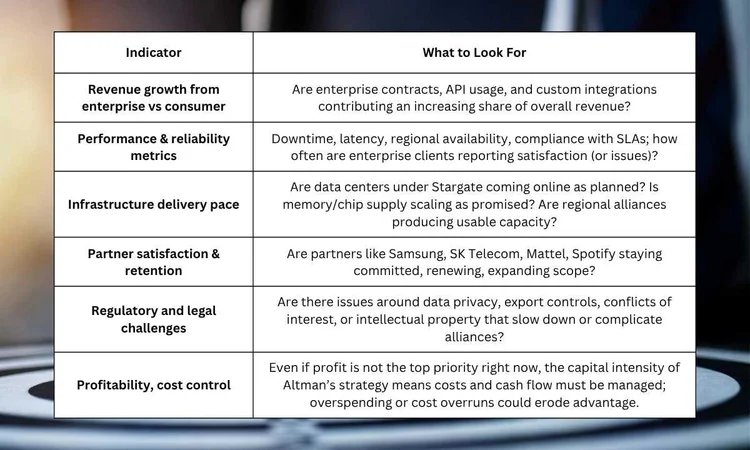
7. What to Watch Next: Indicators of Success or Trouble
To assess whether Altman’s alliance-led enterprise strategy is working, observers can monitor certain signals:
8. Conclusion
Sam Altman’s strategy at OpenAI is evolving: from creating consumer excitement to building enterprise trust; from being model-makers to ecosystem-builders; from riding the hype of AI to structuring long-term, infrastructure-driven value.
Through new alliances, app integrations, hardware and chip supply agreements, data-center infrastructure (the Stargate project), regional partnerships, leadership alignment, Altman is seeding the foundations of what might be the next phase of OpenAI’s journey: one that is enterprise-scale, globally distributed, resilient, and embedded into mission-critical workflows.
There are risks, no doubt, capital intensity, technical complexity, competitive pressures, regulatory uncertainties, but the potential payoffs are also huge. If Altman pulls it off, OpenAI may shift from being perceived as a player that amazes to one that powers the industry.
For businesses, AI service providers, and governments, Altman’s approach is a signal: in the coming years, partnerships will matter as much as models; infrastructure matters as much as outputs; trust and governance will be non-negotiable. And CEOs everywhere will need to recognize that in AI’s enterprise era, alliances aren’t optional; they’re essential.










Leave a Reply
Your email address will not be published.