

[Source - Bloomberg]
A Shift in Microsoft’s DNA
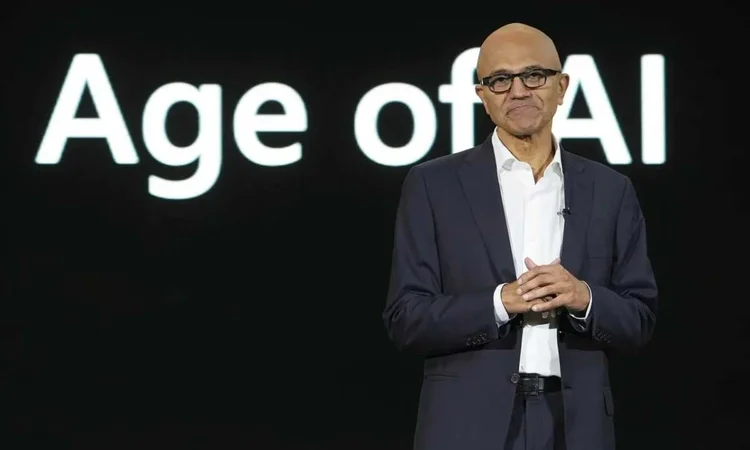
When Satya Nadella took over Microsoft over a decade ago, the company was already a giant, but it needed direction. Under his stewardship, Microsoft moved from being a Windows- and Office-centric firm into a cloud-first, mobile-first innovator. Now, Nadella believes the next seismic shift is artificial intelligence (AI). He isn’t treating it as just another new feature or product line; it’s a foundational pivot, a time to redefine Microsoft’s identity.
In recent months (and years), Nadella has made multiple announcements, organizational changes, and strategic investments that reveal Microsoft’s path forward: from building discrete software products to becoming an intelligence engine, a platform that empowers everyone, everywhere, to build, interact, and achieve more through AI.
This blog explores why Nadella is making this shift, what it means for Microsoft and its stakeholders, and the larger technological and economic landscape that’s making this moment inevitable.
1. The “Software Factory” Isn’t Enough Anymore
One of Nadella’s recent key messages is that Microsoft’s original identity, as a “software factory”, no longer suffices. The idea of software factories implies building finished, task-specific applications, deploying them, and updating them. But Nadella argues that what the world now needs is something more adaptive, more embedded: an intelligence engine.
“We must reimagine every layer of the tech stack for AI, infrastructure, to the app platform, to apps and agents.”
This is not simply about adding AI to existing products. It’s about redesigning the infrastructure, platforms, and user experiences from the ground up with AI at the center. When the foundational layers, data centers, AI models, and developer tools are built for AI first, the results scale more seamlessly and have a deeper impact.
2. Platform Shift: Generative AI and General-Purpose Technologies
Nadella sees AI not just as a new tool but as a platform shift. Historically, Microsoft has navigated a few major platform transitions: desktop PCs, the internet, mobile, cloud, and now AI.
He often refers to recent advances in natural language processing, reasoning engines, and agentic models. These technologies are pushing Microsoft toward what he calls “intelligence everywhere”, agents and copilots embedded in all applications, empowering users to do more with less friction.
The generative AI wave, GPT-type models, large language models (LLMs), and multi-modal AI mean applications aren’t just reactive tools but proactive assistants. Microsoft is investing in Copilots, Azure AI, and agentic architectures to leverage this.
3. Democratizing Innovation and Access
Another major driver is Nadella’s vision to bring AI’s benefits to everyone, not just large organizations, tech developers, or wealthy consumers. Microsoft under Nadella is emphasizing empowerment: enabling people, businesses, and entire countries to leverage AI.
For example:
Commitment to skilling millions of people (e.g. in India), helping address skills gaps so more people can participate in the AI economy.
Building tools and platforms (Copilot, Azure AI, etc.) so that citizen developers, small businesses, and non-tech-savvy users can also build intelligent agents or use AI-powered workflows.
This democratization is both a socially conscious move and a smart business bet: more users, more data, more adoption, and deeper embedding in daily workflows.
4. Economic Imperatives: Productivity, GDP, Competitive Edge
Nadella often frames the AI bet in economic terms. He points out that general-purpose technologies, historically, steam, electricity, computers, internet, have driven large boosts in productivity, GDP growth, and competitiveness. AI is the next such shift.
In Microsoft’s case:
AI can enhance productivity for users, using Copilot in Office 365 (“Microsoft 365 Copilot”), helping write, organize, and analyze faster.
Internal efficiencies: Microsoft itself uses AI to write code, optimize operations, and build better internal tools. This both reduces cost and sets an example.
Strategic positioning: AI is becoming central to how cloud computing, software as a service (SaaS), developer tools, operating systems, etc., work. Microsoft’s ability to lead here could define its relevance and market share in the coming years. If AI becomes as ubiquitous as email or search, being a leader in infrastructure, platforms, and agents is critical.
5. Restructuring Microsoft’s Organization to Reflect AI Priorities
To shift focus properly, Nadella is reorganizing Microsoft. For example:
Appointing Judson Althoff as CEO of Commercial Business, consolidating sales, marketing, and operations under him. This allows Nadella and engineering orgs to be “laser focused” on technical work: AI science, data center build-outs, systems architecture.
Establishment of new engineering groups: e.g., CoreAI – Platform and Tools, which brings together Azure AI, GitHub tools, developer infra, etc., to build the AI stack.
These moves reflect a recognition that organizational structures built for the software era may not be optimal for agentic AI, platform ubiquity, or deep technical innovation across the stack.
6. Dealing with Challenges: Trust, Ethics, and Human Work
Nadella doesn’t pretend this shift has no risks. He frequently talks about responsible AI, ethics, safety, bias, and making sure AI aligns with human values.
He also recognizes that beyond the tech, the harder problem is people: changing how people work, changing expectations, retraining, and reorganizing. AI shifts roles and workflows.
In essence, Microsoft under Nadella is trying to perform a balancing act: move aggressively in AI, but maintain trust, safety, and human oversight.
7. The Big Picture: Why Timing Matters

Why now? Several converging trends make this moment critical:
AI breakthroughs: Large language models, reasoning engines, multimodal AI, these afford capabilities that were theoretical not long ago.
Infrastructure readiness: Microsoft has built a vast cloud infrastructure (Azure), data centers, partnerships (e.g., with OpenAI), and a developer tools ecosystem, prerequisites for scaling AI.
Market demand: Businesses, governments, and individuals are all expecting more from digital systems. There is pressure and opportunity; if Microsoft doesn’t seize it, others will.
Geopolitical and economic pressures: Competing globally in AI is not just about profit but influence, national competitiveness, and regulation. Microsoft wants to ensure it’s a leader, not following behind.
Because of these, boldness is justified. Microsoft seems to believe that going slowly risks losing relevance; going aggressively, if done well, may deliver a big payoff.
8. What This Means for Microsoft, Its Users, and the Tech Ecosystem
Some implications of Nadella’s shift:
For Microsoft: The engineering, R&D, and product development budgets will be more AI-centric; priorities (and resources) will shift. Some areas may get deprioritized if they don’t align with the AI-vision. Also, the company culture may keep evolving, expect more emphasis on machine learning, data scientists, AI researchers, and agent developers.
For Users and Customers: More AI-enabled tools (Copilots, etc.), more automation, more productivity. But also concerns about cost, privacy, and bias. Users will need to adapt workflows.
For Developers and Partners: New APIs, platforms, tools to build AI-first applications. Opportunity to innovate in areas that earlier lacked enabling infrastructure. But also more pressure on capability: AI safety, alignment, performance.
For Society and Governance: Increased need for regulation, oversight, and ethical frameworks. Microsoft’s leadership in responsible AI may influence how the whole industry's norms are set.
9. Risks and Obstacles Microsoft Must Navigate

[Source - The Digital Speaker]
The path isn’t without danger. Some of the key risks include:
Ethical and trust issues: Misuse of data, errors in AI, AI bias, concerns over surveillance or misuse could damage reputation.
Regulatory pressure: Different countries have different rules. Navigating privacy, security, and AI regulation will be complex (e.g., EU, India, etc.).
Technical limitations: AI models can hallucinate, require huge energy, large data, and may have unforeseen consequences. Scaling safely is hard.
Organizational inertia: Changing how people work, reorganizing teams, and shifting culture is always difficult. Resistance from stakeholders, legacy product lines, etc.
Competition: Big players like Google, Amazon, Chinese firms, and open source communities are also aggressively pushing AI. Microsoft needs to maintain differentiation.
10. Conclusion: Microsoft’s Next Chapter
Satya Nadella’s shift toward AI reflects more than a product roadmap; it looks like a rebirth of Microsoft’s operating philosophy. The goal is to become the foundational intelligence layer for the next generation of software, work, and human-machine collaboration.
If successful, Microsoft under Nadella won’t just sell software or services; it will empower individuals, businesses, and societies to build with intelligence built in. It’s a daring move, ambitious, risky, urgent. But in an era where the gap between leaders and laggards in AI may define domination in tech and the economy, Nadella seems unwilling to settle for anything less than leading.










Leave a Reply
Your email address will not be published.