
Sam Altman is a name synonymous with trailblazing in artificial intelligence (AI). As CEO of OpenAI, he has one foot deeply in the future, shaping the architecture of intelligence, redefining what machines can do. Yet, Altman also recently shared something unexpected: a yearning to farm. Yes, farming. To till soil, drive tractors, and harvest crops. Why would someone who funds cutting-edge compute clusters dream of dirt under fingernails? What does this tell us about the future of AI, work, and human identity?
In this article, we examine what has driven Altman to express this “back to earth” desire, what the statements reveal about his views on AI and human worth, how farming fits into the picture of his life right now, and what wider meaning it might have for the rest of us.
1. What Altman Actually Said
Several recent interviews capture Altman’s reflections:
In a conversation with Axel Springer CEO Mathias Döpfner, Altman said he believes there will come a time when an AI could perform better as CEO of OpenAI than he can, and when that happens, he would be “nothing but enthusiastic.”
His backup plan? Farming. Altman owns a farm, and he says he spends some of his time on it and finds joy in the manual tasks: driving tractors, harvesting crops.
He also noted how, before the explosion of ChatGPT, he had more time to do farm work and enjoy simpler routines of life.
Altman’s view on AI: It is rapidly advancing, possibly surpassing human intelligence in many tasks by 2030. He expects many traditional jobs will be destroyed in the short term; in the long term, new roles, especially human-centered ones, will emerge.
So farming, in Altman’s mind, is not just a hobby, it’s a kind of philosophical fallback, an alternative domain of work and meaning when machines can do “everything else.”
2. Why Farming Resonates for Him
Altman’s attraction to farming isn’t whimsical. There are several layers to why this career choice appeals to him:
2.1 As Refuge & Reset
Being an AI leader is intense: nonstop decisions, global scrutiny, accelerating timelines, moral and technical uncertainty. Farming offers contrast:
Pace: The cycle of nature, growing, harvesting, tending land, has rhythms that are slower, more immediate, more tangible than the ephemeral world of lines of code or paper releases.
Tangibility: In farming, you see outcomes: plants grow, soil changes, seasons shift. In AI work, progress sometimes feels abstract, invisible improvements behind layers of model architecture.
2.2 Rootedness & Purpose
Humans often derive meaning from creating, maintaining, and nurturing, whether it’s crops, communities, or ecosystems. Farming is one of the oldest forms of meaningful work:
It demands caretaking: soil, water, and living organisms.
It ties you to the earth, the weather, the seasons, and mortality in a way that digital work doesn’t.
Altman has said he cares most professionally about AI and energy; farming is more aligned with his values of tangible, sustainable contribution.
2.3 Identity, Transition, and Human Uniqueness
Altman is thinking ahead toward a future where AI may surpass human intelligence in many domains. In that potential future:
There will still be what machines struggle with: caring, empathy, culture, and nature.
Altman seems to believe that human value in that future will be expressed through roles that center on caring, tending, and connection rather than purely computational or managerial dominance. Farming is archetypally one such role.
2.4 Personal Pleasure (and Privilege)
Let’s not ignore that Altman already has the means to own properties in places like Napa, Hawaii, etc., and to maintain farms and ranchland. These aren’t modest patches; they’re retreats, sometimes high-end real estate with agrarian use. He has farmhands, but also the personal pleasure of being outdoors, growing things, stepping away from the relentless digital. It’s part passion project and part escape.
3. Farming as a Metaphor for Our AI Future
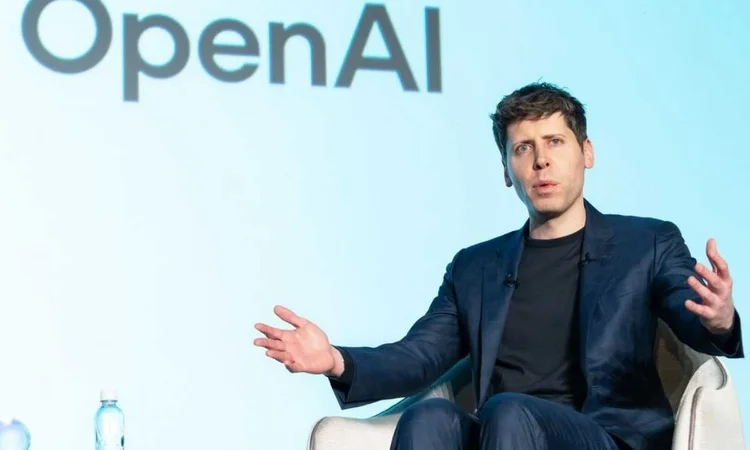
Altman’s remarks are relevant not just as personal aspiration, but as signal flags: clues to how people in AI leadership view their role, how they see the human future, and what might matter when machines become more capable.
3.1 The Shift in What Work Means
For centuries, work was about producing what machines (or others) couldn’t: muscle strength, craftsmanship, care. Then came automation of most manual tasks; now we’re automating cognitive tasks. Where does human identity derive meaning when many decisions or tasks are handled by machines?
Farm work represents something more “grounded,” something machines may replicate in capability but perhaps not in meaning, context, or in the human satisfaction derived from connection to nature.
3.2 New Jobs & Human Domains
Altman expects many jobs to vanish, but also believes new ones, likely human-centred, will arise. Roles involving care, stewardship, community, relationships, art, and ethics, these are harder to outsource. Farming is less interchangeable, especially small-scale, regenerative, or local kinds of farming that include complex interdependencies.
3.3 A Statement on Values
Altman’s statement also signals: even if one is deeply invested in building superintelligent AI, one doesn’t believe that human life should reduce to algorithms, or that every domain should be “optimized.” There’s value in what’s slow, messy, and organic.
It also underlines his optimism: instead of fearing obsolescence, he’s planning for what he believes humans will want to preserve or return to.
4. Challenges & Realities of the Farmer Dream
Of course, becoming a full-time farmer is easier said than done. Some tensions and challenges in this vision:
4.1 Physical, Financial & Logistical Constraints
Farming is physically demanding work. Even with mechanization, there are long workdays, seasonal risks (weather, pests, markets).
Land acquisition, upkeep, water rights, regulation, supply chains, and labor – all have friction.
If Altman shifts more time to farming, is he planning commercial-scale agriculture, niche/regenerative, hobby scale, or something in between?
4.2 Scaling vs. Satisfaction
Does the satisfaction come from farming as a hobby or commitment? Running a small farm is different from making it your main profession; scale introduces complexity: profitability, markets, quality, and compliance.
4.3 Identity Shift
Being CEO of OpenAI is high-impact, high-influence. Farming is quieter. For someone used to shaping global discourse and tech policy, moving to work that is invisible globally could feel like stepping down in importance, but perhaps that’s the point.
4.4 Transition Timing
Altman places this possibility in a future when AI might supersede human performance in his role. That implies there’s an as-yet unclear point where he believes he’ll feel less needed in the high-tech leadership role, or that machines can perform leadership functions better. That transition is fraught: ethical implications, community expectations, corporate continuity, leadership vacuums.
5. What This Means For Others

Altman’s remarks are not only about his personal plans; they have wider implications for how people think about work, AI, and human flourishing.
5.1 Role of “Fallback” Careers
Many people assume a career path is linear: climb, peak, sustain. Altman’s idea of a fallback (and embracing it) suggests a humility and planning for redundancy: preparing identity beyond role. It may encourage a cultural shift where people build lives with multiple anchors, one in disruptive tech, another in slower, tangible work.
5.2 Respecting Non-Tech Domains & Balance
The digital age has privileged tech work; many other forms of work (farming, crafts, caregiving) are undervalued. Altman shining a spotlight on farming could lead to more respect and investment in such domains, agritech, local food systems, and sustainable agriculture.
5.3 Values in an AI-Dominated World
What values persist when machines get smarter, empathy, care, stewardship, meaning, nature. Altman’s choice signals that these values matter deeply and may define human identity in epochs of dramatic technological change.
5.4 Life Beyond Productivity
There is increasing talk about human flourishing beyond productivity metrics: mental health, connection, purpose. Farming taps into that, slowing down, being in the land, being connected to things that grow and die. In a world obsessed with speed and scaling, this can be a counterpoint.
6. A Balanced Assessment: Is It Realistic?
Let’s assess how realistic it is that Altman actually becomes a full-time farmer, and what might happen along the way.
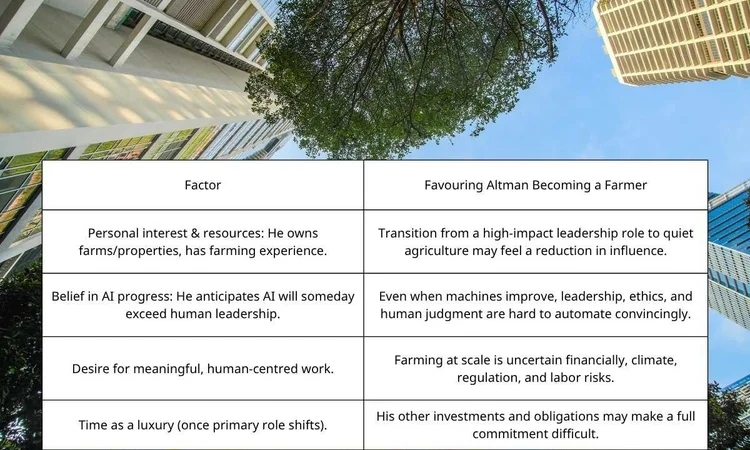
Realistically, Altman probably won’t wake up one day and abandon OpenAI to drive a tractor full-time, unless several conditions change dramatically: AI maturity, his personal priorities, perhaps a different shape for his life. But using farming as a symbol, a possible path, is very credible for him, given his wealth and options.
7. In Broader Context: AI, Work, and Human Flourishing
Altman’s statement intersects with larger debates:
Universal Basic Income / Redistribution: If many jobs vanish, how do we support people? Altman has, in other settings, been supportive of UBI-like thinking. Farming may be one of many “alternative economic models” people might (or need to) pursue.
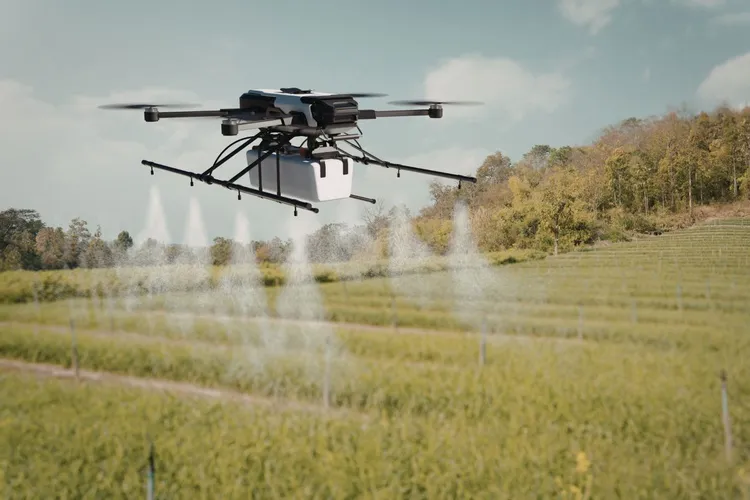
Agritech & Sustainable Food Systems: Perhaps Altman’s farming isn’t purely manual; maybe it includes innovation, sustainable agriculture, regenerative methods, technology in farming, linking AI, energy, ecology.
Mental health & burnout in tech leadership: Farming is often romanticised as therapeutic. For many leaders, burnout is real; having a connection to nature can be restorative.
8. Conclusion: More Than a Career Plan
Sam Altman is looking forward to farming is more than just a “fun backup” plan. It’s a statement. It’s a recognition that humans will still need roles tied to nature, care, and grounding, even in ages when machines surpass us in many intellectual tasks. It’s also about identity, values, and what we want our lives to mean when our own capacities are no longer unique.
Farming might become Altman’s future. Or perhaps just a retreat, a metaphor, a reminder. Either way, it’s meaningful that someone at the frontiers of AI is calling farming not a step backward, but a possible next chapter.


Leave a Reply
Your email address will not be published.