

The world of Artificial Intelligence (AI) has evolved at a staggering pace in recent years, driven by technological breakthroughs, vast amounts of data, and cutting-edge hardware. In this revolution, two names have emerged as true powerhouses: OpenAI and NVIDIA. While OpenAI has become synonymous with developing state-of-the-art AI models like GPT-4, DALL·E, and Codex, NVIDIA has established itself as the backbone of AI processing with its world-leading GPU technology. Together, they are forging a partnership that is transforming the landscape of AI infrastructure and enabling breakthroughs that were once thought impossible.
In this article, we’ll explore how OpenAI and NVIDIA are collaborating to accelerate AI development, the underlying technologies powering their partnership, and what this means for the future of AI.
The Rise of AI and the Need for Scalable Infrastructure
The demand for AI solutions has exploded over the past decade. From natural language processing (NLP) models that power chatbots and voice assistants to deep learning algorithms revolutionizing autonomous vehicles and healthcare diagnostics, AI is touching almost every industry. However, the true potential of AI cannot be unlocked without the proper infrastructure. That’s where the collaboration between OpenAI and NVIDIA comes into play.
AI models, particularly large-scale deep learning models, require vast amounts of computing power. These models often consist of billions of parameters and demand processing capabilities that go far beyond the average consumer-grade hardware. Running these models efficiently, especially during training, requires cutting-edge GPUs that can handle massive parallel computations.
OpenAI's Ambition and Technological Vision
OpenAI has been at the forefront of AI research, continuously pushing the boundaries of what’s possible with machine learning. With its ambitious goal of ensuring that artificial general intelligence (AGI) benefits all of humanity, OpenAI has been focused on creating more powerful, efficient, and capable models. OpenAI’s GPT series of models, including the groundbreaking GPT-4, has demonstrated the ability to generate human-like text, while their other models, such as DALL·E, have opened new frontiers in creative AI.
To train these models, OpenAI requires enormous computational resources. For instance, GPT-3, the predecessor to GPT-4, was trained using a dataset that included hundreds of billions of words and required significant computing power. The training process itself took weeks, if not months, on powerful clusters of GPUs.
OpenAI’s approach involves breaking down complex problems into manageable components, using deep learning techniques that require specialized hardware like Graphics Processing Units (GPUs) to scale their models efficiently. This is where NVIDIA's GPUs come into play.
NVIDIA’s Role: Powering AI with GPUs
[Source - NVIDIA]
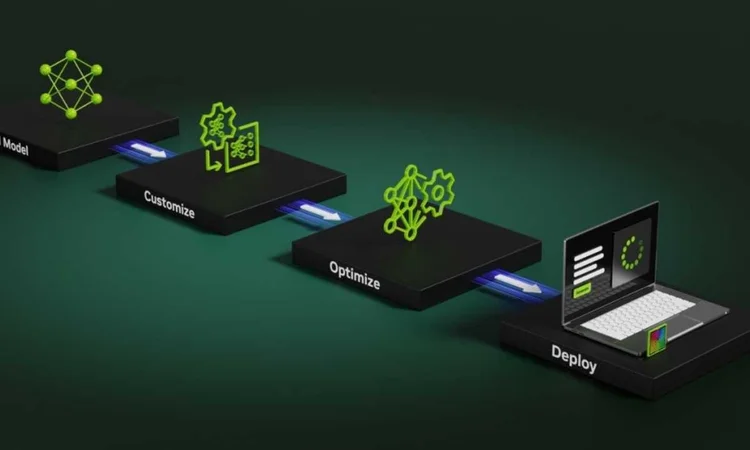
NVIDIA’s GPUs have become the gold standard for AI research and development. Traditionally known for their graphics capabilities in gaming, NVIDIA’s technology has become indispensable in the world of AI. The company’s GPUs, such as the A100 and H100, are optimized for high-performance computing tasks that are central to AI model training, particularly deep learning.
NVIDIA pioneered the use of GPUs for parallel processing, which allows AI models to be trained much more quickly than would be possible on traditional CPU-based systems. GPUs excel in matrix multiplications and other calculations that are fundamental to deep learning. As AI models have grown more complex, the demand for powerful GPUs has only increased. This has led NVIDIA to continually innovate, developing specialized hardware and software platforms for AI workloads.
The company also introduced CUDA (Compute Unified Device Architecture), a parallel computing platform and API model, which has become the foundation of AI training across industries. NVIDIA’s ecosystem of tools, including the NVIDIA Deep Learning Accelerator (NVIDIA DLA), and its software frameworks like TensorRT, are tailored for deep learning models, enabling companies like OpenAI to train their AI systems at scale.
The OpenAI and NVIDIA Partnership: A Perfect Synergy
The collaboration between OpenAI and NVIDIA is a natural fit. As OpenAI's AI models have become more sophisticated, the need for advanced computing infrastructure has only grown. This is where NVIDIA’s hardware and software solutions step in to meet OpenAI's demanding requirements.
High-Performance GPUs for Faster Training
At the heart of this partnership is the utilization of NVIDIA’s GPUs. OpenAI leverages NVIDIA’s cutting-edge hardware, such as the A100 and H100 Tensor Core GPUs, to accelerate the training of its large language models (LLMs). These GPUs offer the massive parallel processing power required for training complex neural networks, allowing OpenAI to run large-scale models with billions of parameters.
The GPUs’ ability to handle immense amounts of data in parallel dramatically reduces the time needed to train AI models. For instance, training a model like GPT-3 on a traditional CPU-based system would take months, but with NVIDIA’s GPUs, OpenAI can complete the same process in a fraction of the time. This has allowed OpenAI to iterate on its models faster, leading to the creation of more powerful AI systems, such as GPT-4.
Scaling AI Models with DGX SuperPOD
NVIDIA’s DGX SuperPOD, a powerful AI supercomputer, is another cornerstone of the partnership. This system is designed to provide the computing power required for training extremely large AI models. The DGX SuperPOD is a cluster of interconnected NVIDIA DGX systems, each containing multiple GPUs, designed to scale up to meet the needs of AI research at the highest levels.
By leveraging NVIDIA’s DGX SuperPOD, OpenAI can manage the massive computational load required for training its largest models. These systems allow OpenAI to scale its AI infrastructure efficiently and handle complex tasks like training models on massive datasets without compromising performance.
NVIDIA Omniverse: A Platform for AI Collaboration
Another aspect of the collaboration between OpenAI and NVIDIA involves the NVIDIA Omniverse. This platform is a virtual collaboration environment where AI researchers, developers, and companies can come together to create and test simulations, virtual environments, and digital twins. Omniverse’s support for AI workflows makes it an ideal space for OpenAI to integrate its models and work alongside other industry leaders.
OpenAI's research benefits from NVIDIA’s Omniverse in a variety of ways, including enhancing simulation environments where AI systems can be tested and trained in complex, dynamic virtual worlds. The platform enables OpenAI to test its AI models in scenarios that would be difficult, expensive, or dangerous to replicate in the real world.
Transforming AI Research and Deployment
[Source - XTB.com]
The OpenAI-NVIDIA collaboration doesn’t just speed up model training; it’s also reshaping how AI research is conducted and deployed in the real world. With powerful infrastructure, OpenAI can explore new frontiers of AI capabilities, from general-purpose language models to specialized systems for industries like healthcare, gaming, and robotics.
Empowering the OpenAI API
One of the most visible outcomes of this partnership is the OpenAI API. Through this API, OpenAI has made its GPT-based models accessible to developers and businesses worldwide. By tapping into NVIDIA’s GPUs and infrastructure, OpenAI can offer a scalable, cloud-based solution that provides real-time access to powerful AI models. Whether it’s chatbots, content generation, or enterprise automation, businesses of all sizes are utilizing OpenAI’s technology, powered by NVIDIA’s robust hardware.
AI Democratization
Another significant impact of the OpenAI-NVIDIA partnership is the democratization of AI. By making powerful AI tools more accessible through APIs and platforms like Microsoft’s Azure, OpenAI, backed by NVIDIA's infrastructure, is enabling companies of all sizes to leverage AI without needing to build and maintain expensive, high-performance computing systems.
This collaboration is not just about AI development in the lab; it’s about making these technologies accessible and scalable in production environments. This has profound implications for industries ranging from healthcare (where AI can accelerate drug discovery and diagnostics) to finance (where it can improve decision-making and fraud detection).
Looking Ahead: The Future of OpenAI and NVIDIA's Partnership
[Source - REUTERS]
As AI continues to evolve, the collaboration between OpenAI and NVIDIA is likely to grow even deeper. Here are some key areas where we can expect further innovations:
Next-Generation AI Models: With the increasing complexity of AI models, the need for even more powerful GPUs will continue to grow. NVIDIA is already working on the next generation of AI hardware, and OpenAI will likely be one of the first to benefit from these advancements.
AI Ethics and Safety: As AI systems become more autonomous, ensuring they are ethical and safe becomes a critical concern. OpenAI’s commitment to the responsible development of AGI, combined with NVIDIA’s hardware for large-scale AI training, will likely play a significant role in shaping the future of AI safety and ethics.
Quantum Computing: NVIDIA is also exploring the potential of quantum computing, which could revolutionize AI even further. OpenAI and NVIDIA’s future partnership might expand to include quantum computing technologies, accelerating AI training and making it possible to tackle even more complex problems.
Conclusion: A Powerful Partnership for a New Era of AI
The partnership between OpenAI and NVIDIA represents the future of AI infrastructure. Through their combined expertise in AI research, deep learning, and high-performance computing, they are not just advancing the field; they are reshaping how AI is developed, deployed, and scaled. With NVIDIA providing the hardware and OpenAI leading the way in model development, this dynamic duo is accelerating the pace of innovation and making AI more accessible to everyone.
As AI continues to permeate every aspect of our lives, the collaboration between OpenAI and NVIDIA will remain a critical factor in shaping the next generation of intelligent systems, from autonomous machines to creative AIs and beyond. Together, they are building the infrastructure for a smarter, more connected world.








Leave a Reply
Your email address will not be published.